

Uwe Rosenberg is best known for his extensive economic games. These include Agricola, Caverna, Atiwa, and the monumental A Feast for Odin, which can be considered the designer’s magnum opus. His portfolio also contains abstract games such as Nova Luna and Patchwork, as well as acclaimed card games including Bohnanza and Mamma Mia!
Fields of Arle belongs to the first of these groups. It is an economic game for one or two players in which we develop a farm in East Frisia. We grow grain and flax, raise animals, drain moors, build dikes, process materials, and transport goods to nearby towns and villages.
It is also Rosenberg’s most autobiographical game. Arle is a real village where his father was born and his parents were married. One of the Travel Destinations featured in the game is Beemoor, where the designer’s father grew up on a secluded farm. Some of the Buildings also have counterparts in Rosenberg’s family history.
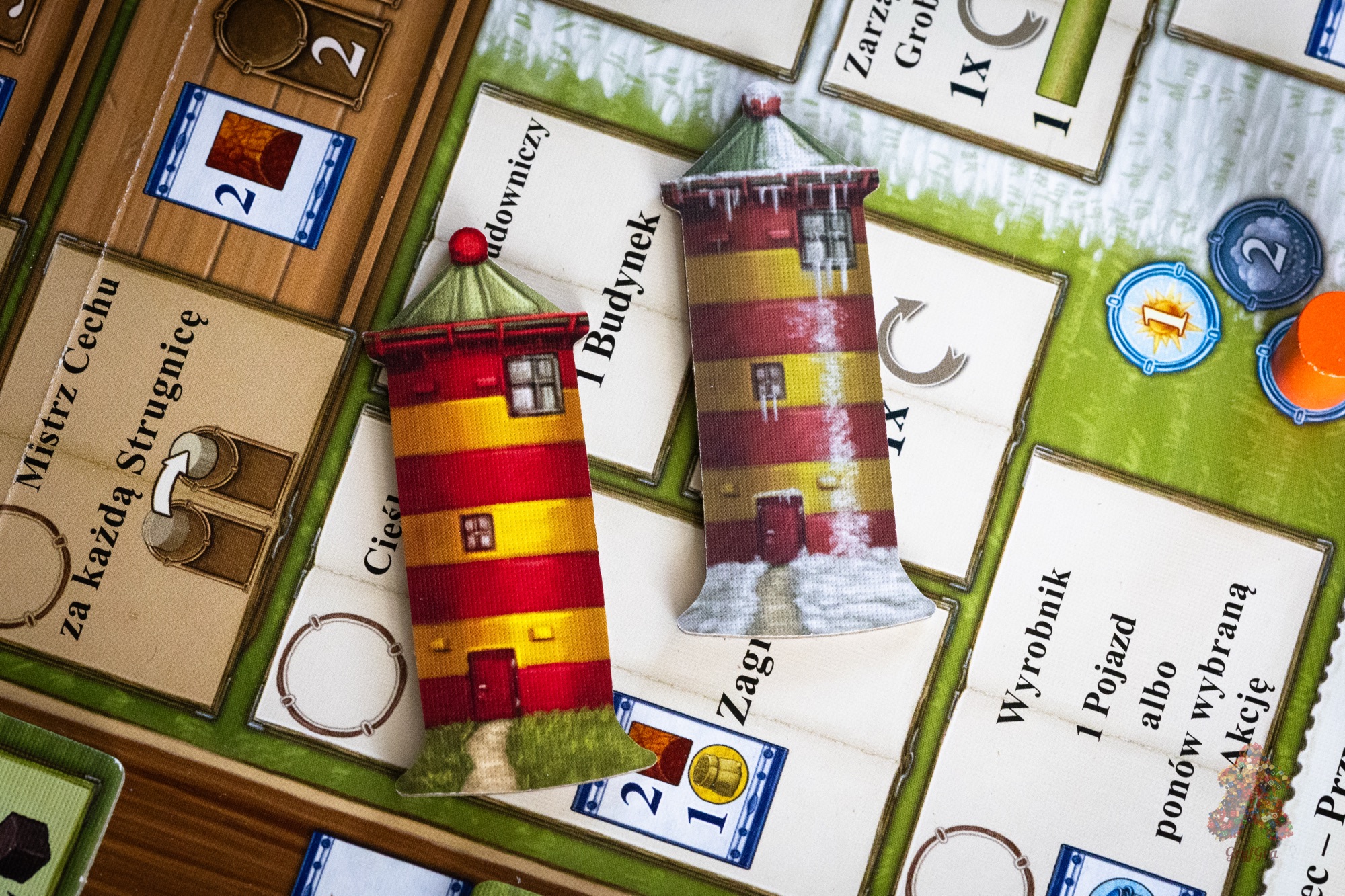
The Polish edition was published by Rebel. Let us see what life as the owner of an East Frisian estate looks like and whether its numerous Action Spaces, Tools, Vehicles, and materials come together to create an efficiently functioning farm.
Gameplay
In Fields of Arle, each player receives a Home Board and a Storage Board containing their Barn and Travel Destinations. The Home Board has spaces for crops, animals, Forests, and Buildings, although a substantial part of the land is initially unavailable. The upper section is covered by flood-prone land, while the lower part contains Moors.
The Home Board also features a Goods Track used to record the amount of Food, Grain, Hides, Flax, and Wool in our possession. Wood, Clay, Peat, and their processed counterparts are represented by separate tokens and pieces.
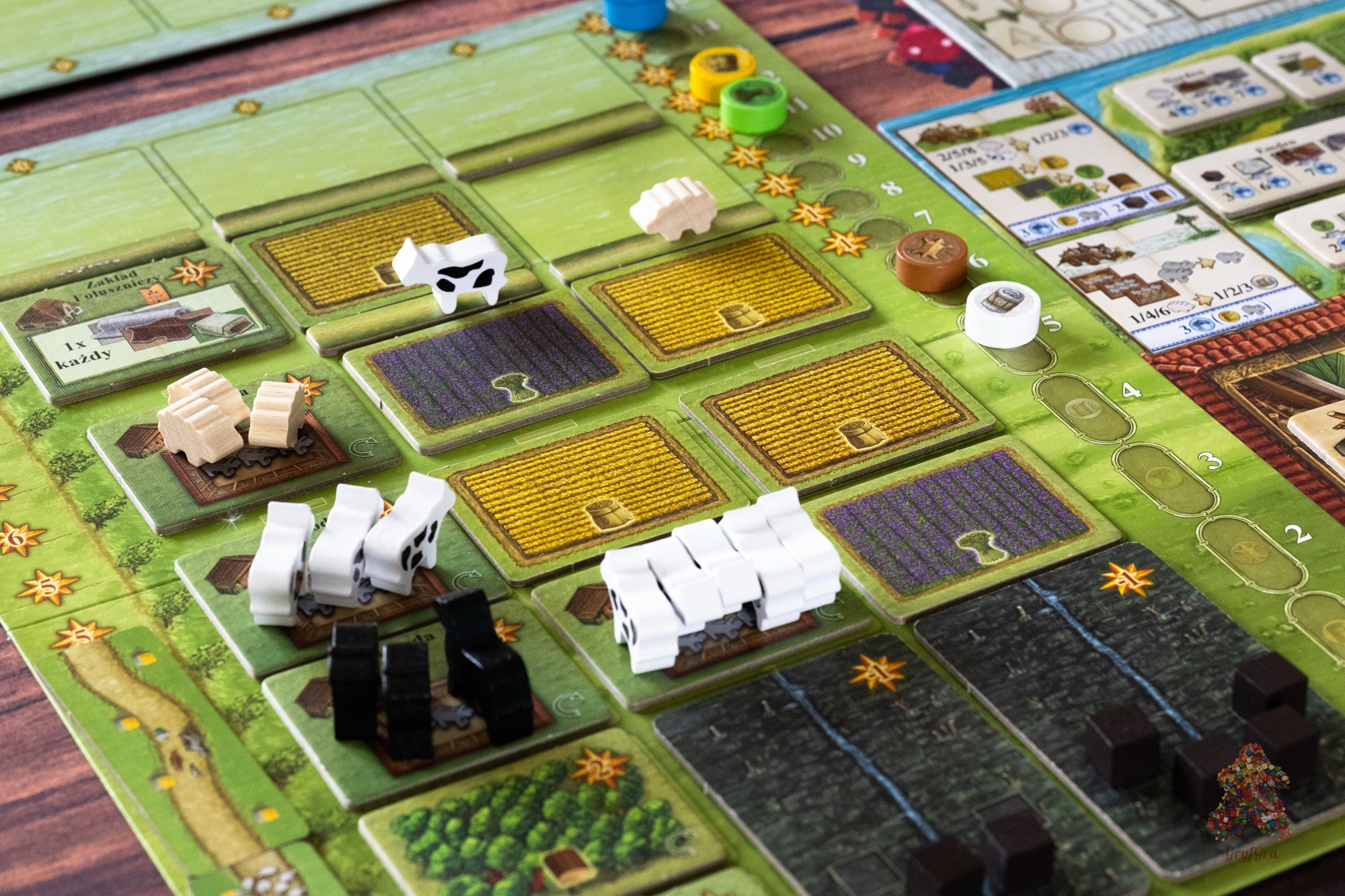
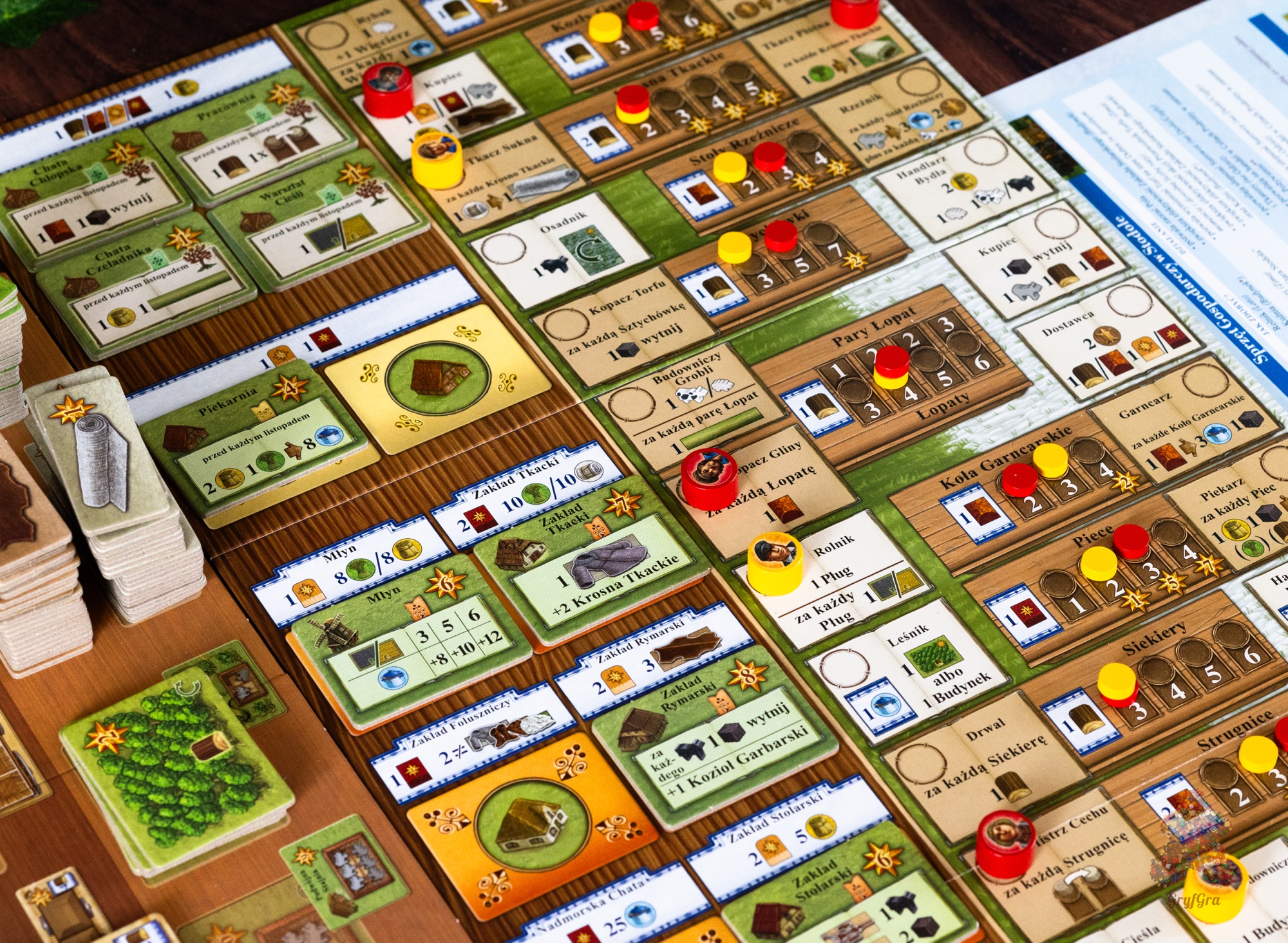
The central Game Board and Supply Board are placed between the players. The former contains the Action Spaces, Tool Tracks, and Buildings that can be constructed during the game. The latter helps organise the many Fields, Forests, Stalls, Vehicles, Plows, Peat Boats, Fabrics, and other components.
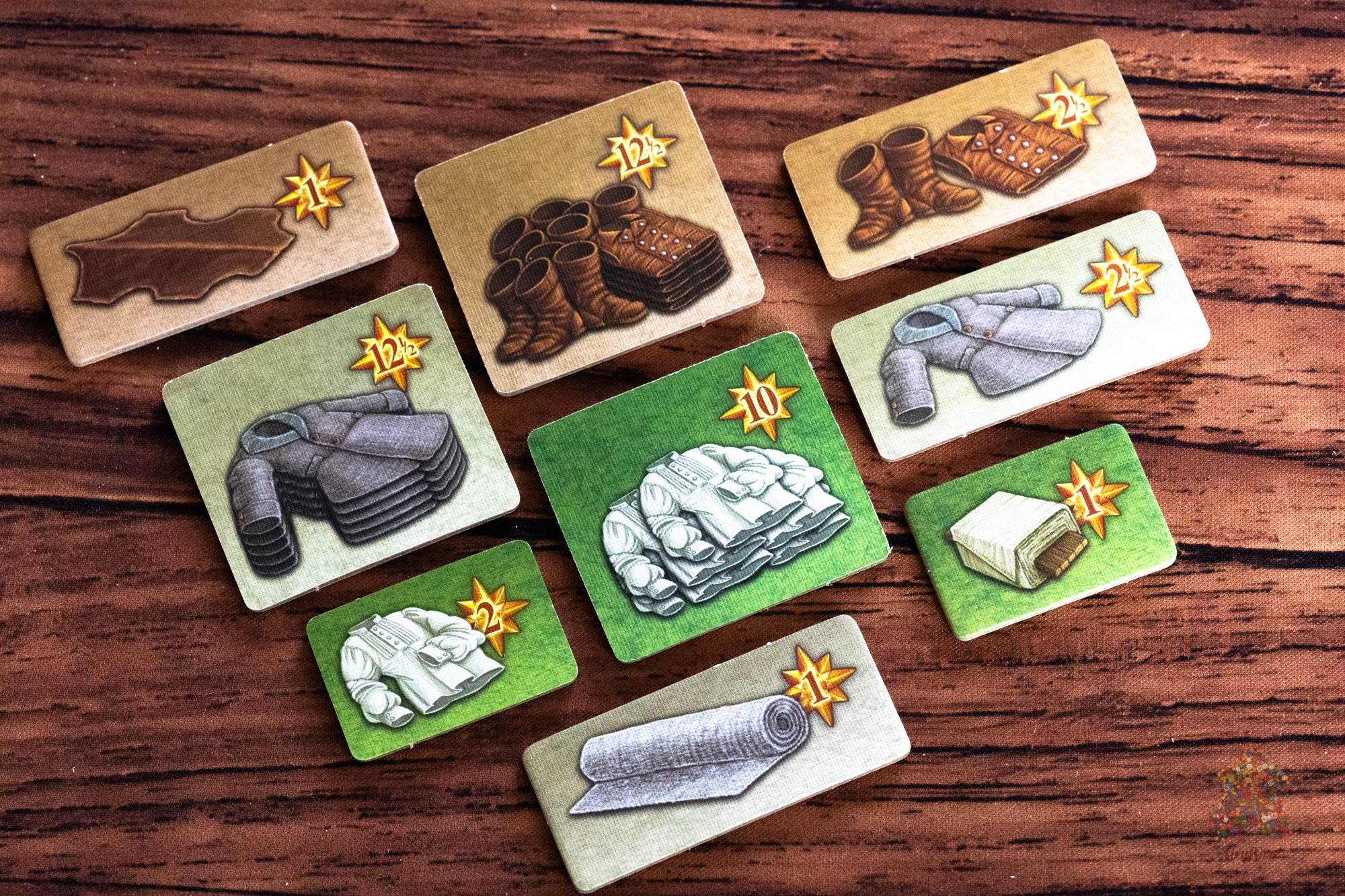
The objective is to develop the most successful estate. We receive points for Buildings, Tools, Vehicles, stored goods, Animals, and completed journeys, among other things. We may also lose points for undrained Moors, unprotected flood-prone land, and shortages during Inventorying.
Nine Half-Years
The game takes place over nine Half-Years, alternating between Summer and Winter. Together, they represent four and a half years of developing our farm. Each Half-Year consists of three phases: Preparation, the Work Phase, and Inventorying.
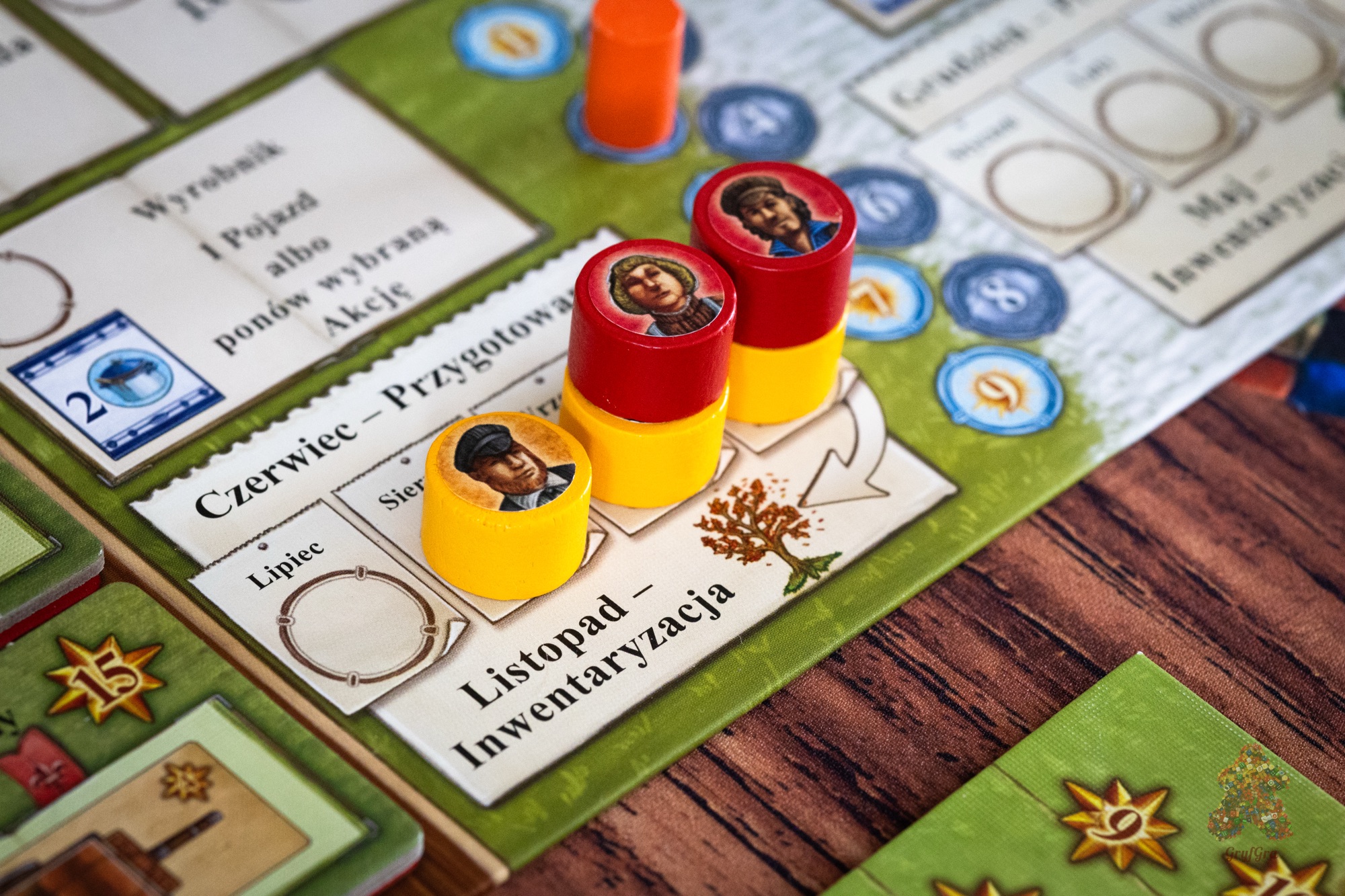
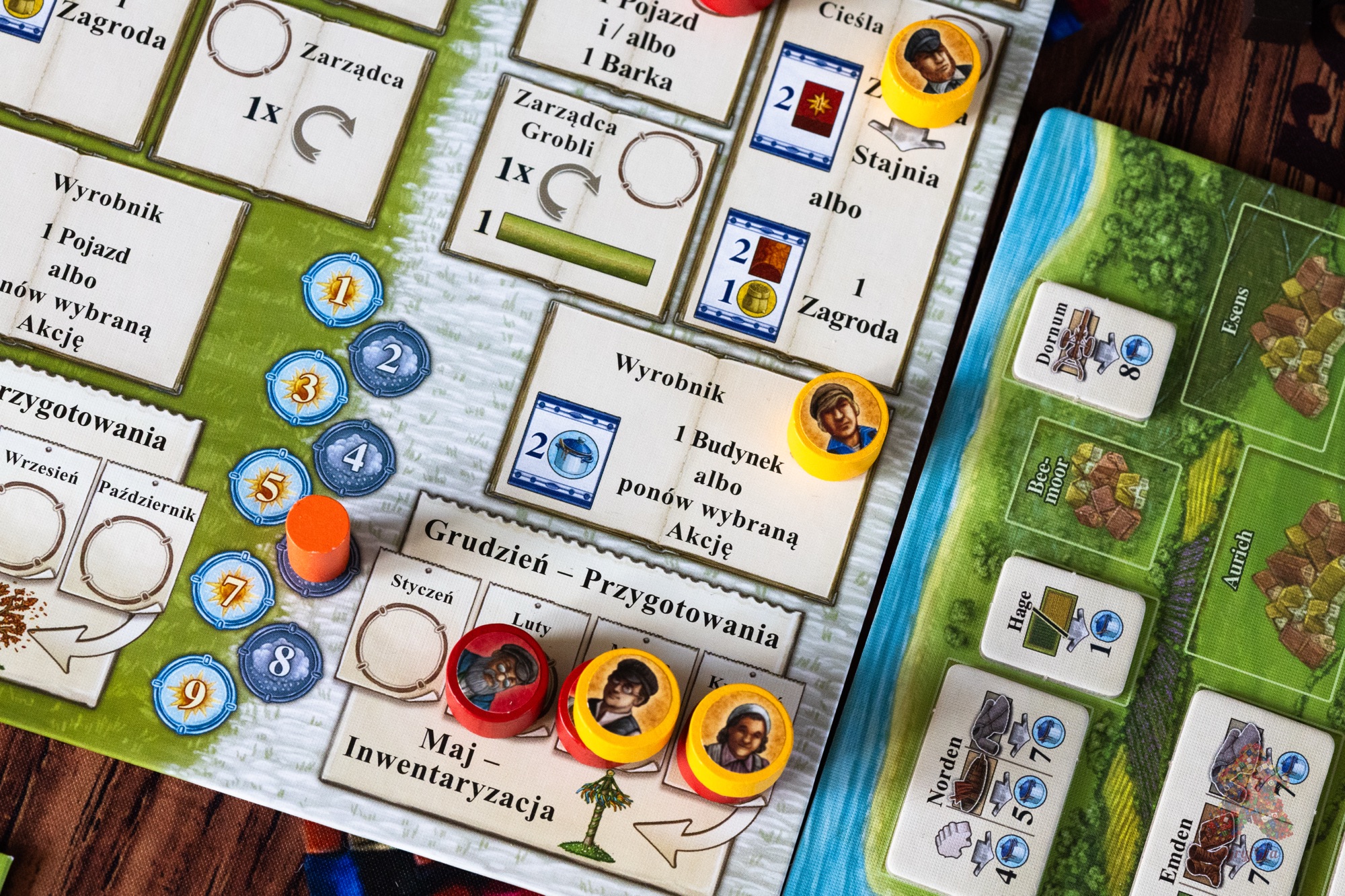
During Preparation, we place our four Workers on the spaces corresponding to the coming months. Then, during the Work Phase, the players alternate placing one Worker at a time on an unoccupied Action Space.
The Game Board is divided into Summer and Winter sections. Fifteen Action Spaces are available during each Half-Year, while the other half of the board remains inactive. In Summer, we can plow Fields, build Dikes, drain Moors, obtain Wood and Clay, or construct Buildings. Winter gives us more opportunities to process goods, trade Animals, acquire Vehicles, and develop the farm in other ways.
Once per Half-Year, one of the players may use an Action Space belonging to the opposite season. Doing so affects who becomes the Starting Player during the following Half-Year. The Laborer Action Space also allows us to repeat an already occupied action after paying an additional cost.
Tools
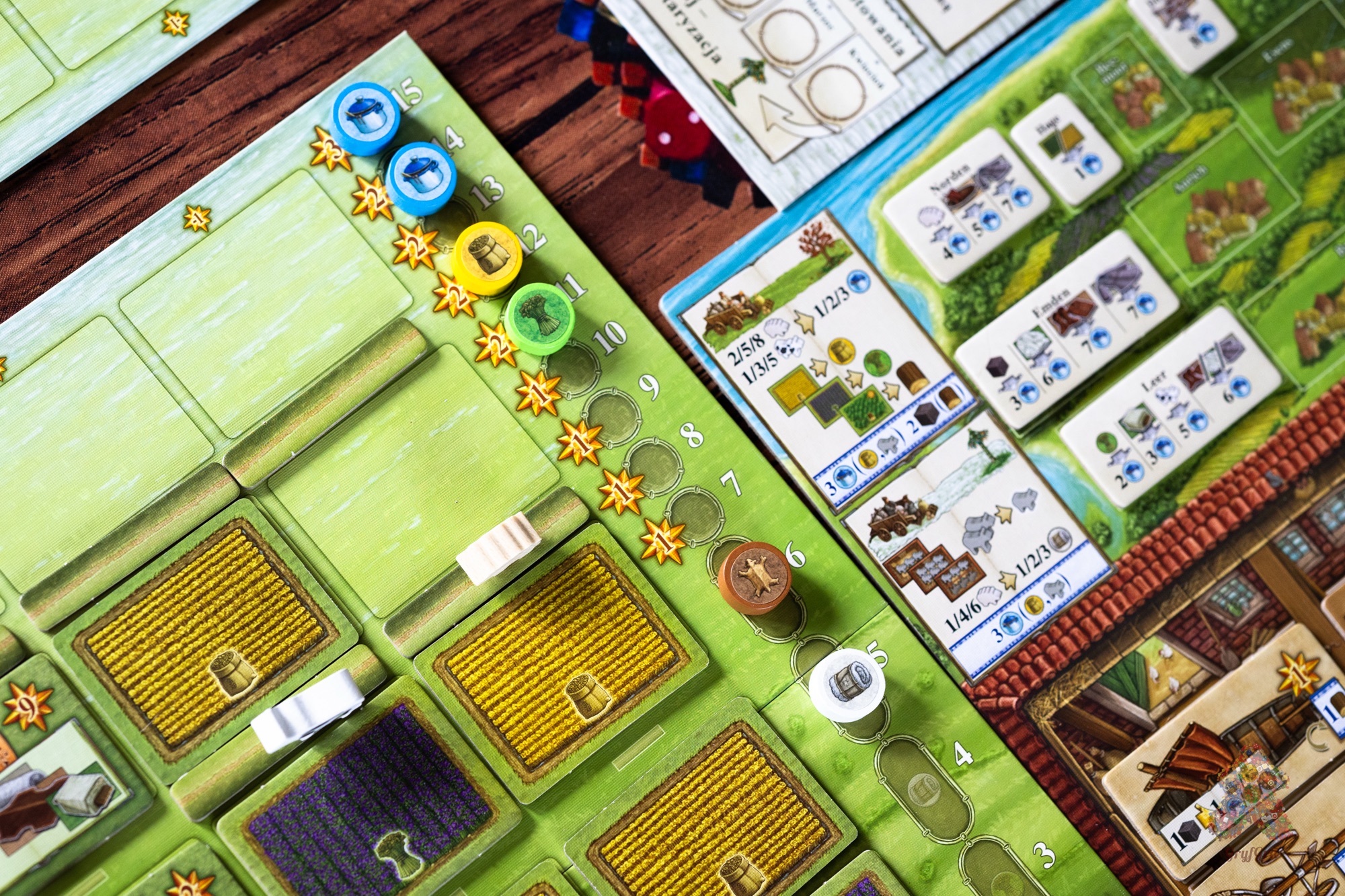
Many Action Spaces are linked to Tools. The Game Board contains ten separate tracks representing Fishing Traps, Looms, Ovens, Shovels, Axes, Workbenches, and other equipment.
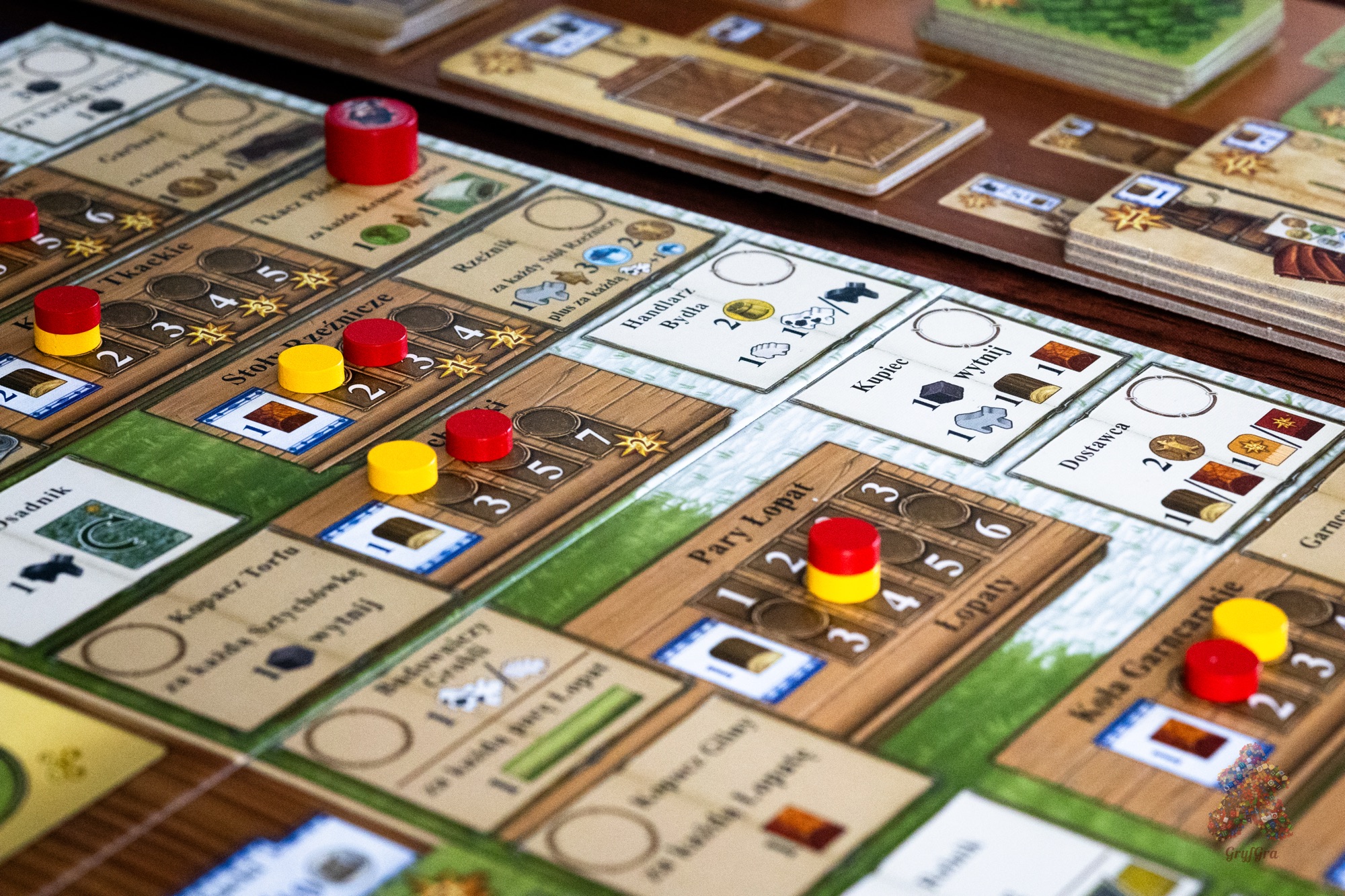
The number of Tools we own determines the strength of the corresponding actions. More Axes provide more Wood, additional Shovels increase our Clay production and Dike-building capabilities, while extra Looms let us process larger amounts of Wool or Flax.
Tools are primarily improved by using the Master Action Space. Each advancement requires us to pay the indicated cost, but the upgrade remains in effect until the end of the game. Some Tool Tracks also provide Victory Points.
Estates, Dikes, and Moors
The usable space on each player’s Home Board is heavily restricted at the beginning of the game. We can reclaim additional land in two ways.
The first is by building Dikes. Moving their tiles towards the flood-prone land creates new lines protecting the estate from the water. Completing a full Dike Line immediately provides access to three new Land Spaces. Reaching the top of the board also allows us to avoid negative points.
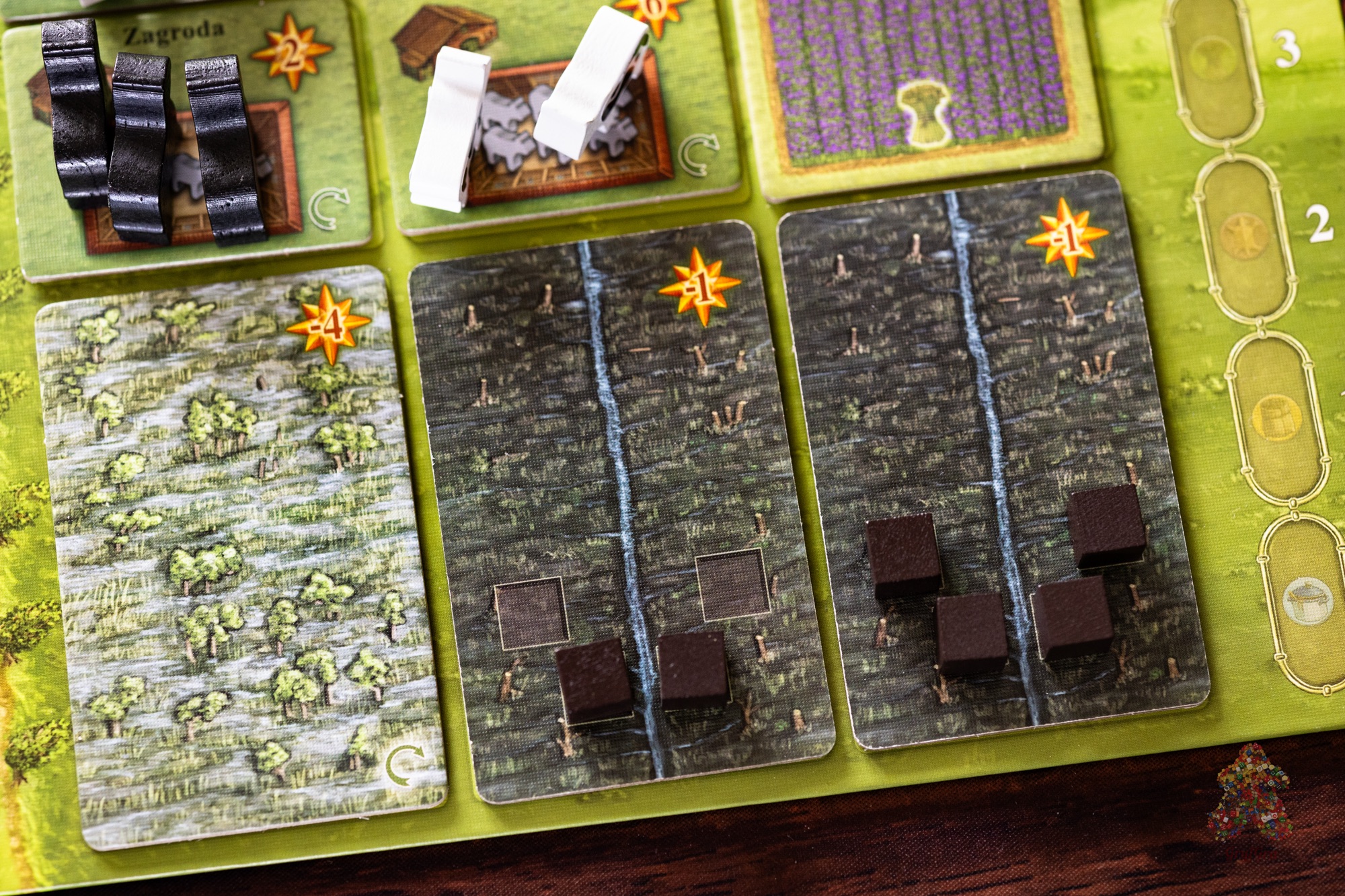
The second method is draining Moors. A flipped tile is filled with Peat, which can then be removed gradually. Once the final Peat piece has been collected, the Moor is removed and the land underneath becomes available.
Reclaimed Land Spaces can be used for Grain and Flax Fields, Forests, Stalls, and Buildings. Fields produce crops, Forests provide Wood, and Stalls and Stables allow us to keep more Animals. Certain tiles can also be upgraded—a Forest can become a Park, a Stall can be turned into a Depot, and a Stable can become a Double Stall.
Animal Husbandry
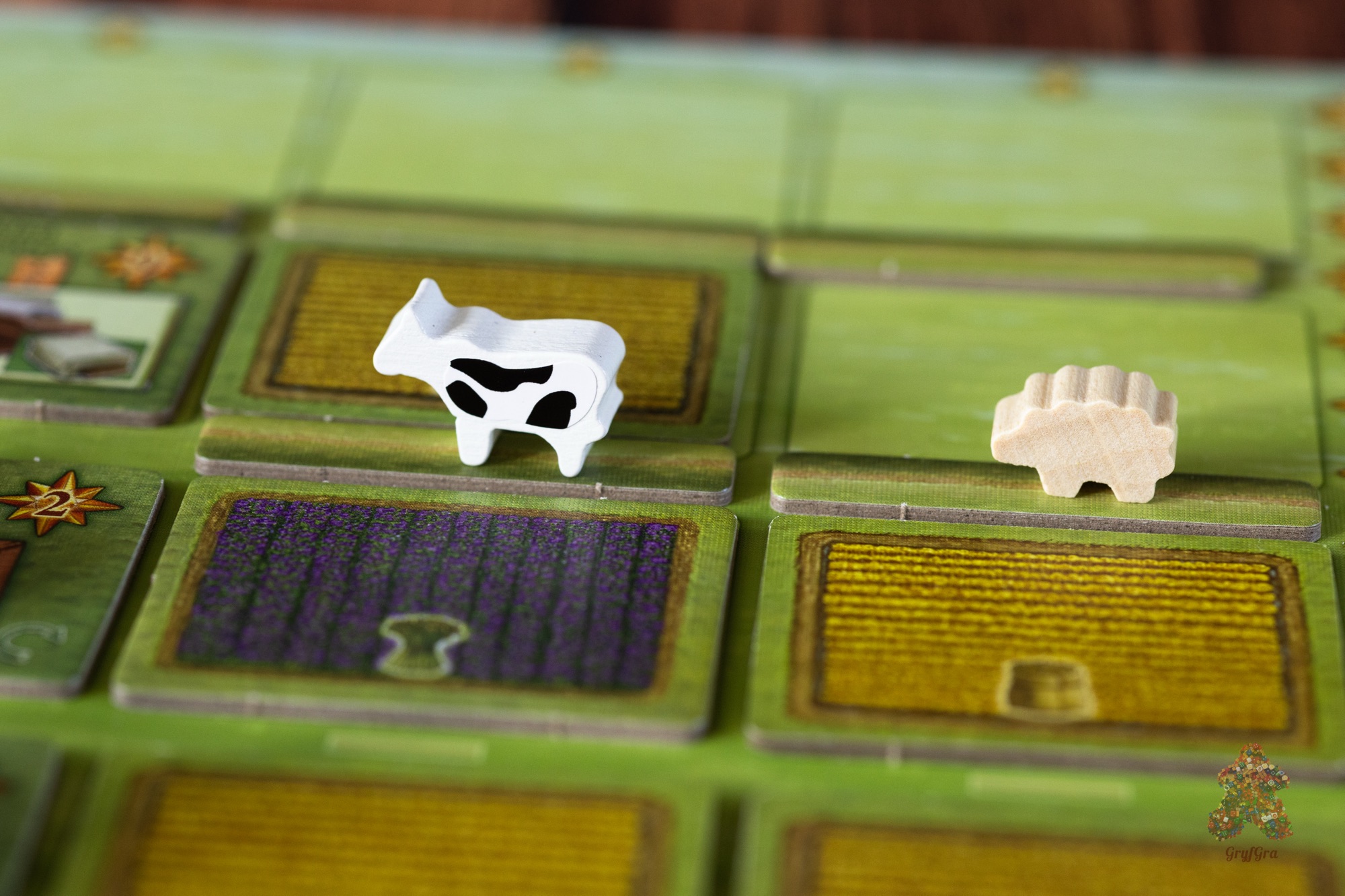
The game features Sheep, Cattle, and Horses. Animals can be kept on empty Land Spaces, in Stalls, Stables, and Parks, or even individually on Dikes. Each type of space has a different capacity.
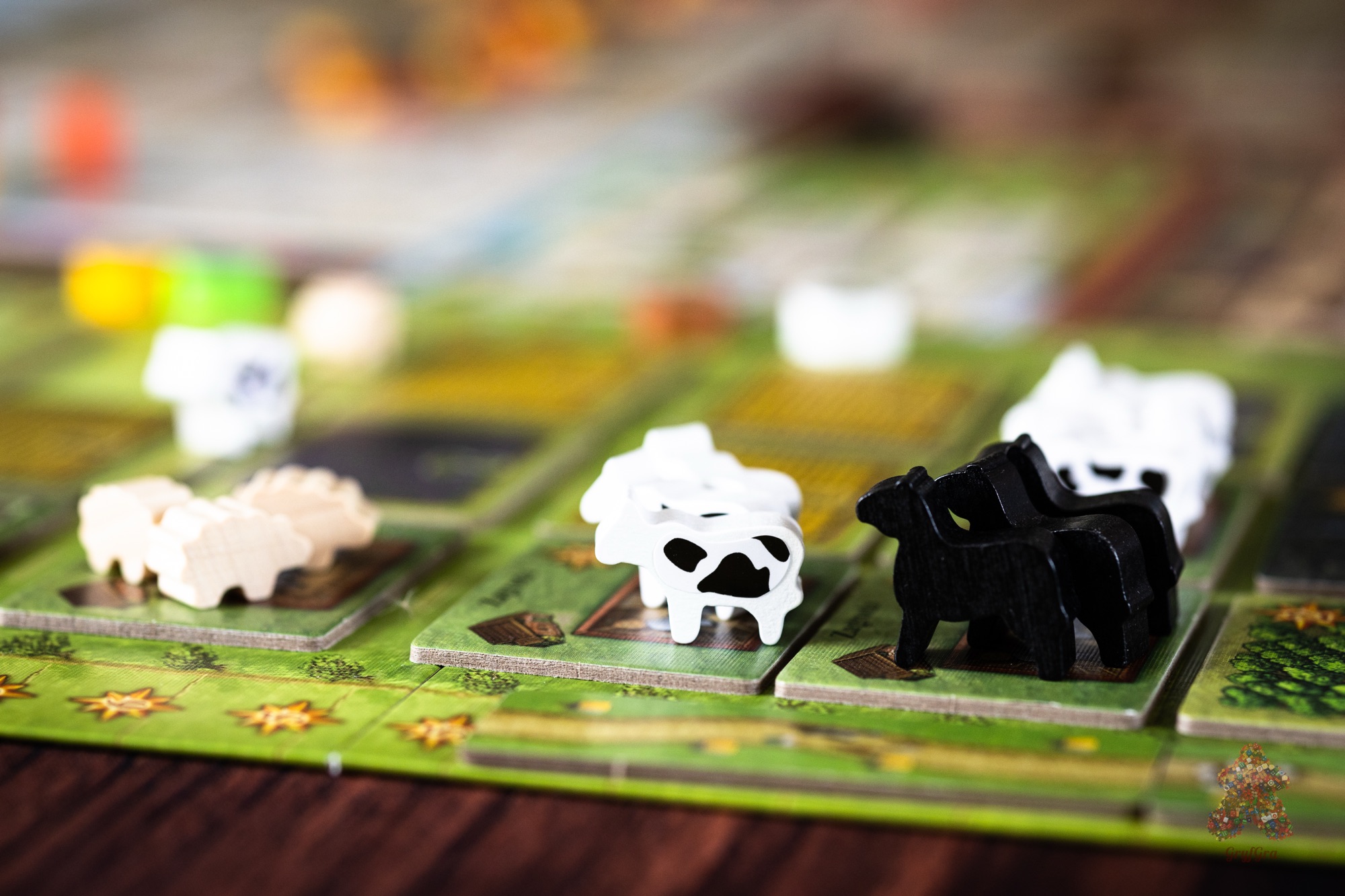
Cattle and Sheep help us obtain Food, Sheep provide Wool, and Horses are required to acquire certain Vehicles and Plows. Pairs of Animals kept in Stalls and Stables reproduce during the May Inventorying at the end of Winter.
Simply collecting the largest possible herd of one species will not produce a good score. At the end of the game, each Animal of the type we own the least of is worth two points. Animals of the second most numerous type are worth one point each, while those belonging to our largest herd score no points at all.
Vehicles and Processing
Plows, Peat Boats, and Vehicles are stored in the Barn. Its capacity is limited, so we cannot accumulate equipment indefinitely. Plows allow us to cultivate more Fields, while Peat Boats let us exchange Peat for goods shown on our Goods Track.
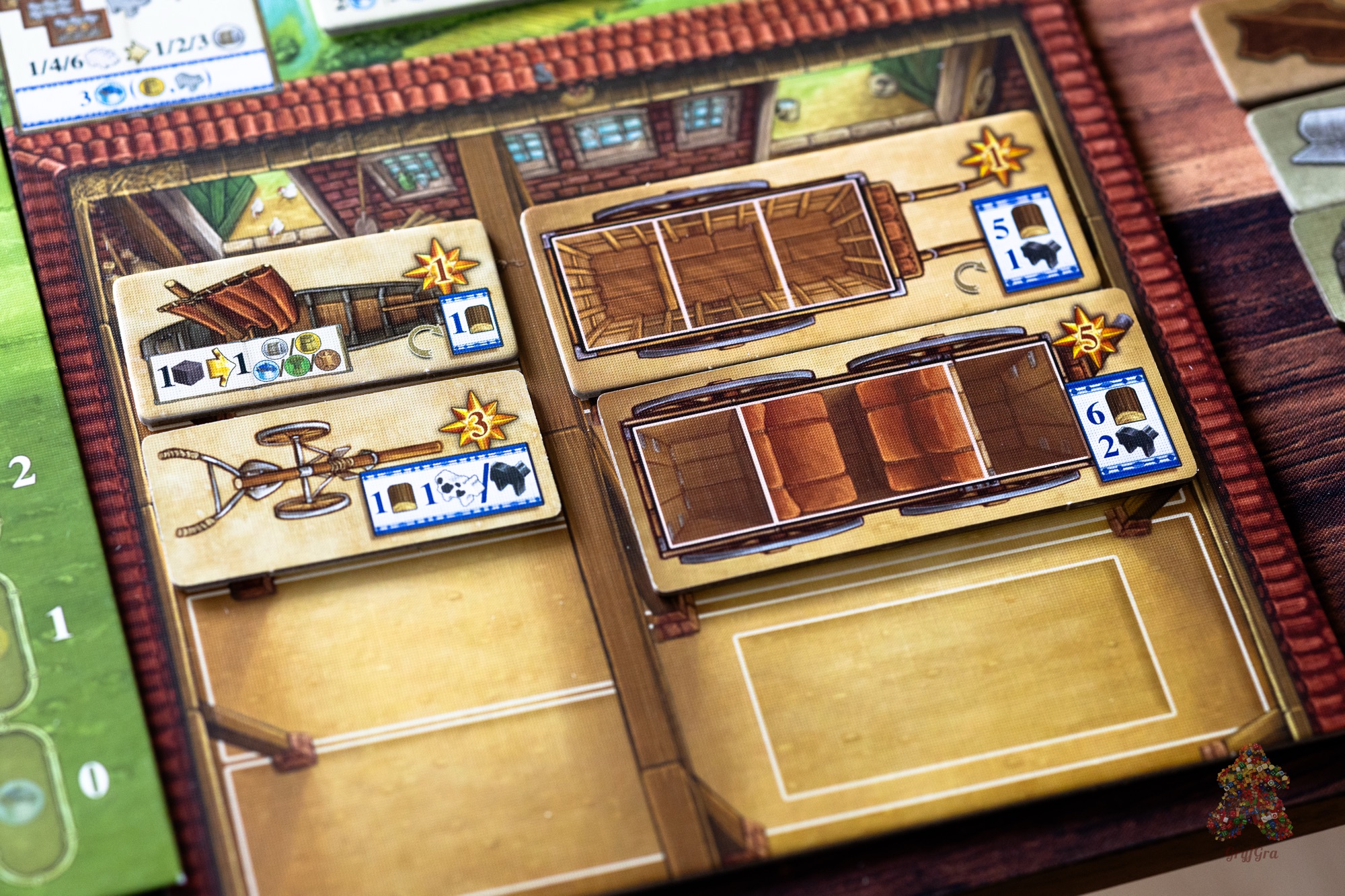
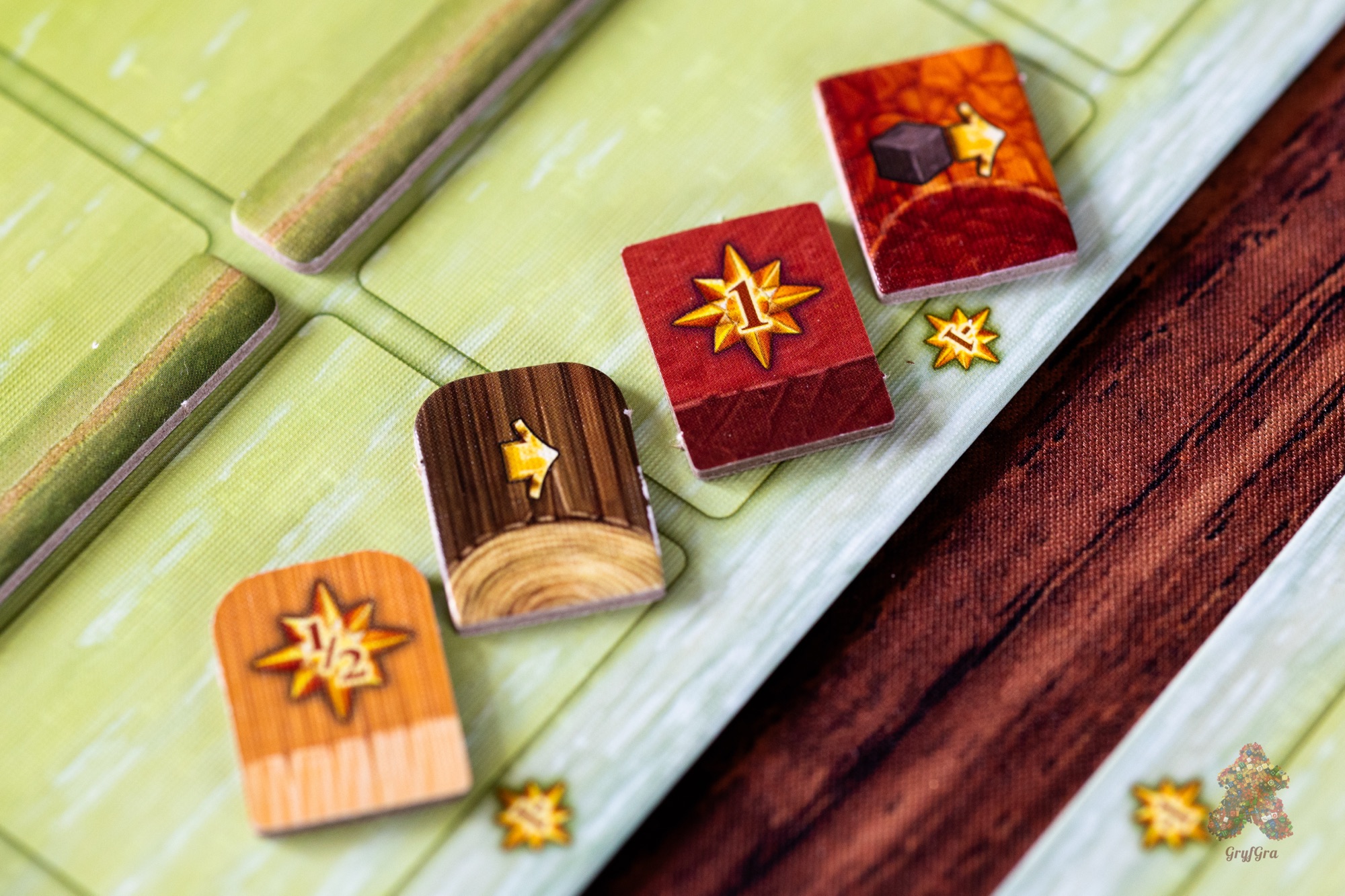
Vehicles have a more complex role. During the Work Phase, we can load them with Building Materials, Fabrics, and Travel Destination Tiles. Wood transported on a Vehicle becomes Timber, while Clay—after paying additional Peat—becomes Brick. Linen, Woolen, and Leather are turned into more valuable Clothing.
The goods remain on the Vehicles until the end of the Work Phase. This means that processed materials cannot be used immediately, and production must be planned in advance.
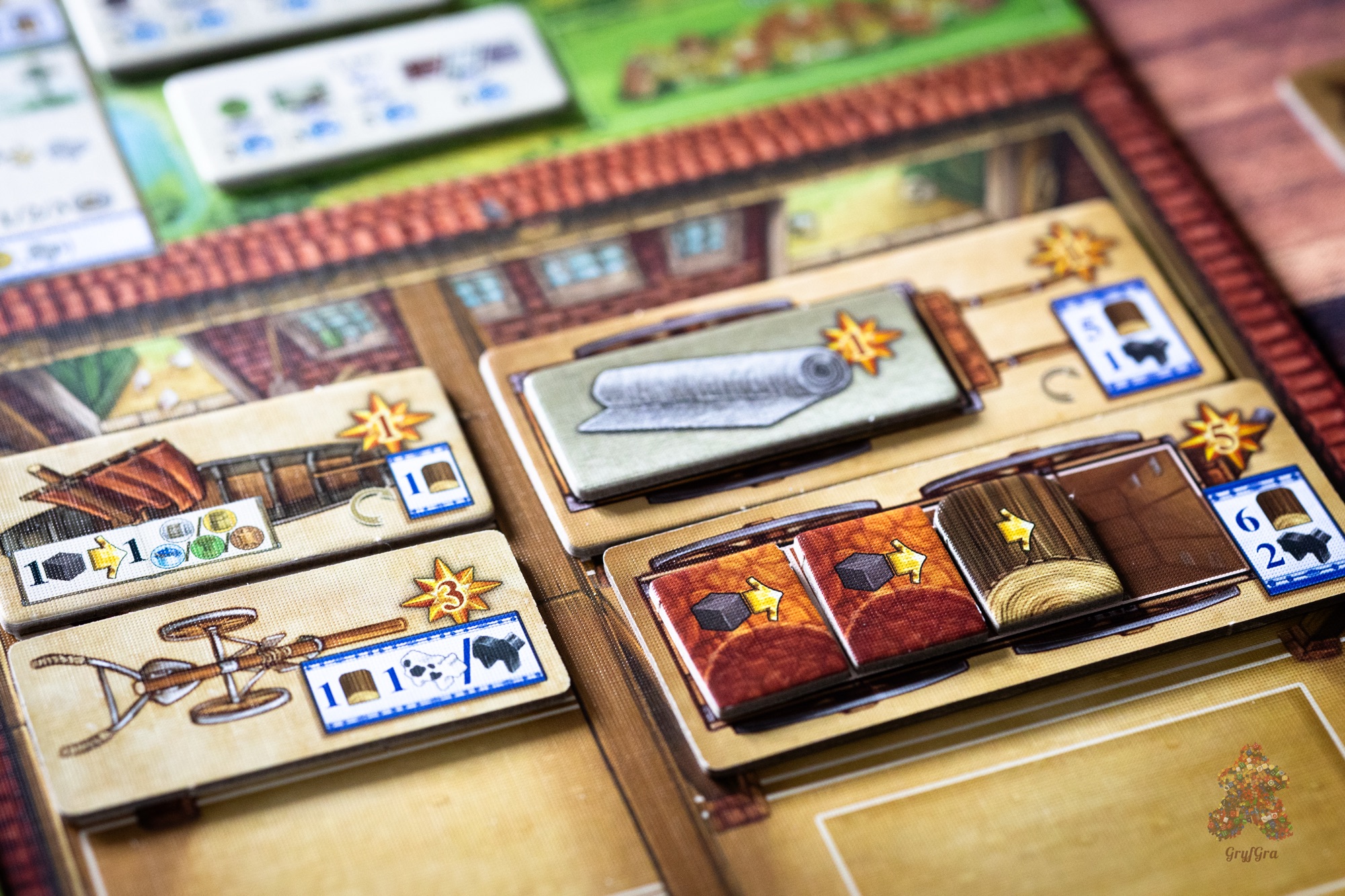
Vehicles differ in cost, size, and the arrangement of their loading spaces. The smallest are primarily useful for processing basic materials. Larger Vehicles can transport Fabrics and allow us to reach more distant Travel Destinations.
Travel Destinations
Each player begins with their own set of nine Travel Destination Tiles. To visit a particular place, we must load its tile onto a Vehicle and immediately sell at least one of the goods shown on it.
In return, we receive Food. Different towns and villages seek different products, including Animals, Peat, Grain, Fabrics, Clothing, and sometimes even Plows, Peat Boats, or Fields.
During Inventorying, completed Travel Destination Tiles are placed on the Travel Track, where they form a road running upwards. The more spaces they cover, the more points we receive at the end of the game.
Inventorying
Once all Workers have been used, Inventorying begins. Its exact course depends on the current season.
At the end of Summer, we first unload our Vehicles. We then receive Food from Sheep and Cattle, harvest Grain and Flax from Fields, and collect Wood from Forests. Finally, we must pay three Food and two Peat for heating.
Winter also begins with unloading the Vehicles. Animals kept in Stalls and Stables may then reproduce, while Sheep provide Wool. This time, the final feeding step requires us to pay only three Food.
Shortages can be partially covered with other goods, but if we are still unable to meet the farm’s needs, we lose points.
End of Game
The game ends after the ninth Half-Year and the final November Inventorying. We then work through an extensive scoring sheet.
We score Fabrics, Clothing, processed Building Materials, equipment stored in the Barn, progress on the Travel Track, upgraded Tools, goods, Buildings, Fields, Forests, Stalls, Stables, and Animals. Points are deducted for remaining Moors, the Moor Tile with the Boardwalk, unprotected flood-prone land, and any shortages recorded during the game.
The player with the most points wins.
Review
Fields of Arle belongs to the category of games in which the basic rules are much simpler than the number of available options might suggest. On your turn, you place a Worker on an Action Space and carry out the corresponding action. That does not sound particularly complicated. The challenge—or perhaps the game’s greatest attraction—begins when you look at thirty Action Spaces, your estate, the Tool Tracks, available Buildings, Vehicles, and the entire range of materials waiting to be processed.
In our case, the first game inspired curiosity rather than intimidation. The sheer number of options encouraged us to explore the different systems and gradually discover possible paths to victory. That does not change the fact that our first play was essentially one long bout of analysis paralysis. Concrete ideas that can be turned into plans only begin to emerge as you become familiar with the relationships between the game’s many elements.
A Lot of Game and a Lot of Components
Setting up Fields of Arle takes time. The box contains numerous boards, tiles, tokens, and wooden pieces, and during the first game it is difficult to remember where everything belongs. After a single play, however, the contents can be organised in a way that makes the next setup considerably easier. The separate Supply Board also helps by giving the many tiles clearly designated places on the table.
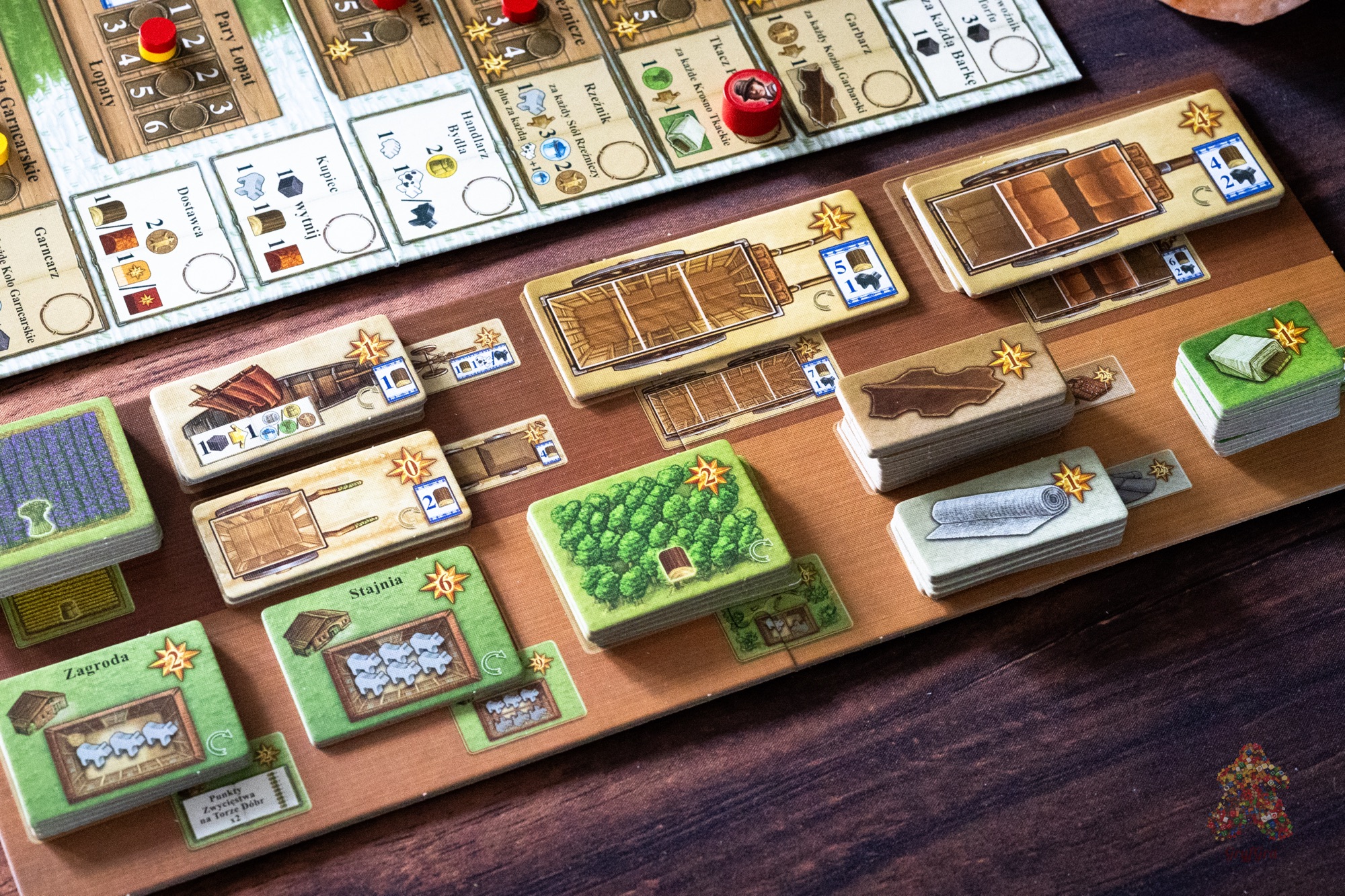
You will need quite a lot of table space. We barely managed to fit everything on a standard 120 × 60 cm table. The number of certain tiles also raises some questions—particularly Fields, Woolen, and Leather. A considerable part of the supply remained unused during our games. Perhaps more experienced players will find a use for larger quantities, but at this stage they seem slightly excessive.
The artwork has the distinctive appearance associated with Rosenberg’s economic games. We would hardly describe Dennis Lohausen’s illustrations as beautiful, but they capture the period and theme effectively. More importantly, the boards remain readable despite the enormous amount of information they contain. The component quality neither impresses nor disappoints—it is in line with what we expected from this edition.
From Summer to Winter
Dividing the Action Spaces between Summer and Winter initially adds to the amount of information that needs to be absorbed. Even during the first game, however, the distinction proves quite intuitive. In Summer, we cultivate the land, build Dikes, and obtain basic materials, while Winter provides more opportunities to process them and develop the farm. Planning soon takes on a pendulum-like rhythm: we prepare for the actions available during the next Half-Year while keeping the approaching Inventorying in mind.
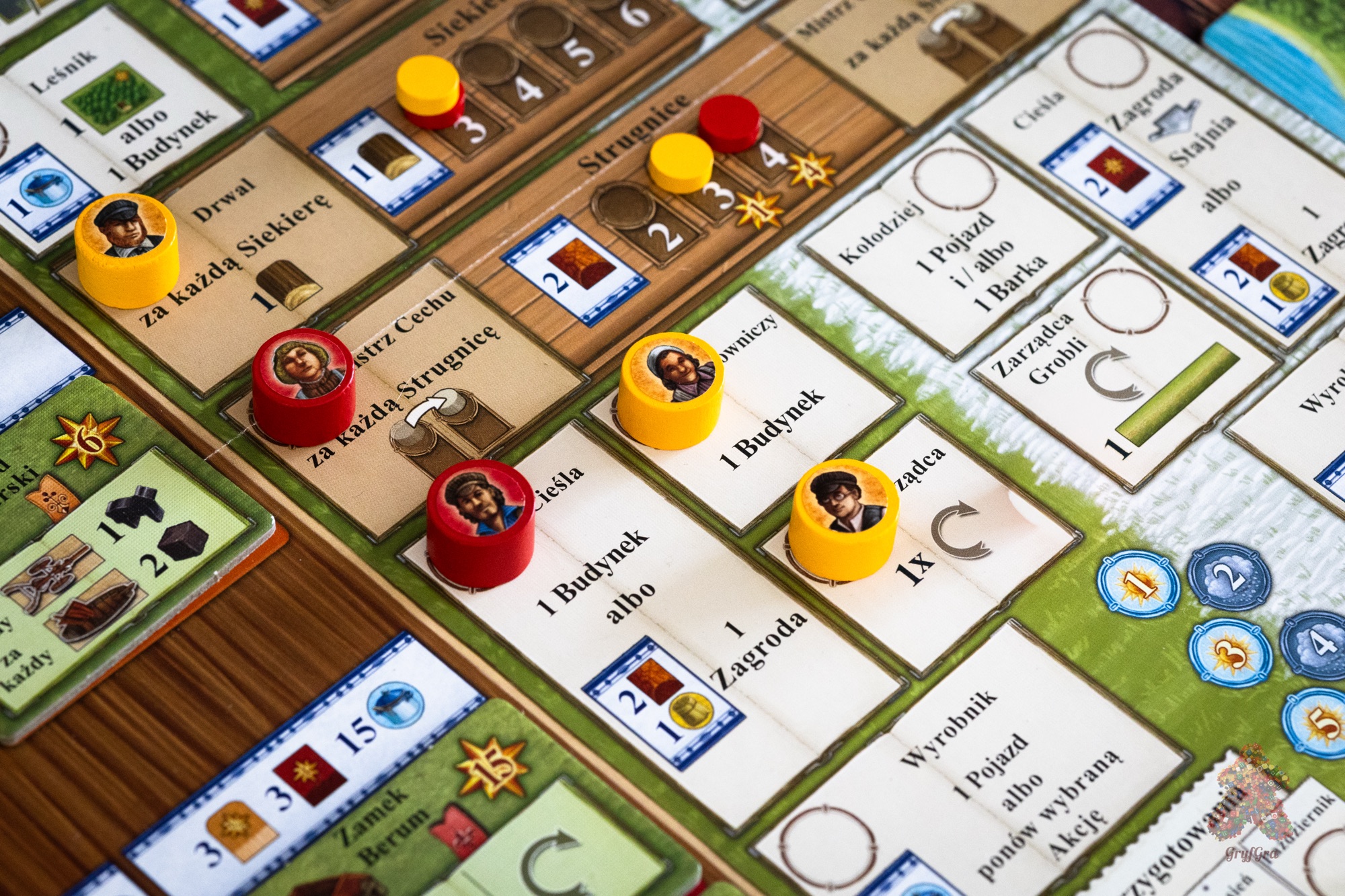
A wide selection of Action Spaces does not mean that the other player’s decisions are irrelevant. Certain activities, such as constructing Buildings, are available in several places, but this is the exception rather than the rule. Your opponent may occupy the Action Space you need and force you to change the order of your moves or revise your entire plan. Interaction does not involve destroying another player’s estate, but the competition for actions is clearly noticeable.
Tools, Dikes, and Moors
Improving Tools is one of the foundations of the game’s economy. Upgrades not only provide points but, more importantly, strengthen the actions connected to them. Regardless of the strategy we adopt, it is difficult to ignore this part of the game entirely. Even Shovels and Axes, which do not score points themselves, make it easier to obtain basic materials and move Dikes.
The development of the estate is closely connected to Moors and flood-prone land. Peat is an important resource, so Moors must first be drained and then gradually emptied. The substantial penalties for leaving them on the Home Board provide additional motivation. Leaving aside the questionable environmental merits of draining peatlands, the mechanism cleverly connects resource production with reclaiming space for further development.
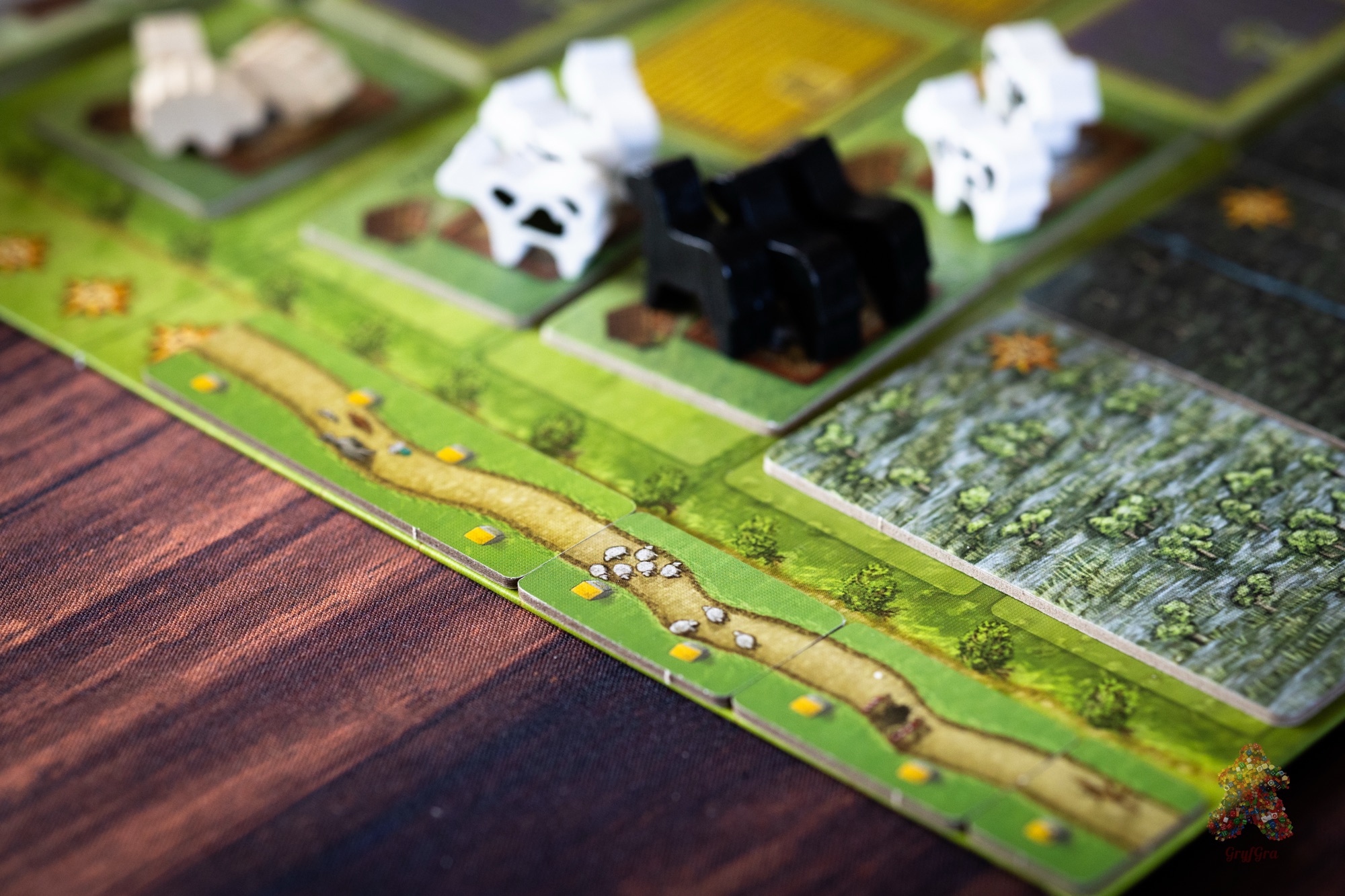
Dikes work in a similar way. At the beginning of the game, when a substantial part of the Home Board is still occupied by Moors, additional land is essential. At the same time, avoiding all Dike-related penalties requires steady work throughout most of the game. We have not yet managed to use every available Land Space, but gradually transforming the Home Board creates a clear and satisfying sense of development.
Wagons Full of Bricks and Food
Processing materials with Vehicles is an interesting idea. We load Wood or Clay onto a Vehicle and receive Timber or Bricks at the end of the Half-Year. It is slightly amusing, but it also provides an effective incentive to expand our fleet. Vehicles are additionally used for transporting Fabrics and completing Travel Destinations, making them an important part of the economic puzzle.
Trading with nearby towns and villages feels slightly stranger. Different products are exchanged directly for Food, as if money had been removed from the entire economic system. It seems to be missing from both the sale and processing of goods. This does not harm the mechanisms, but it makes some exchanges less intuitive from a thematic perspective.
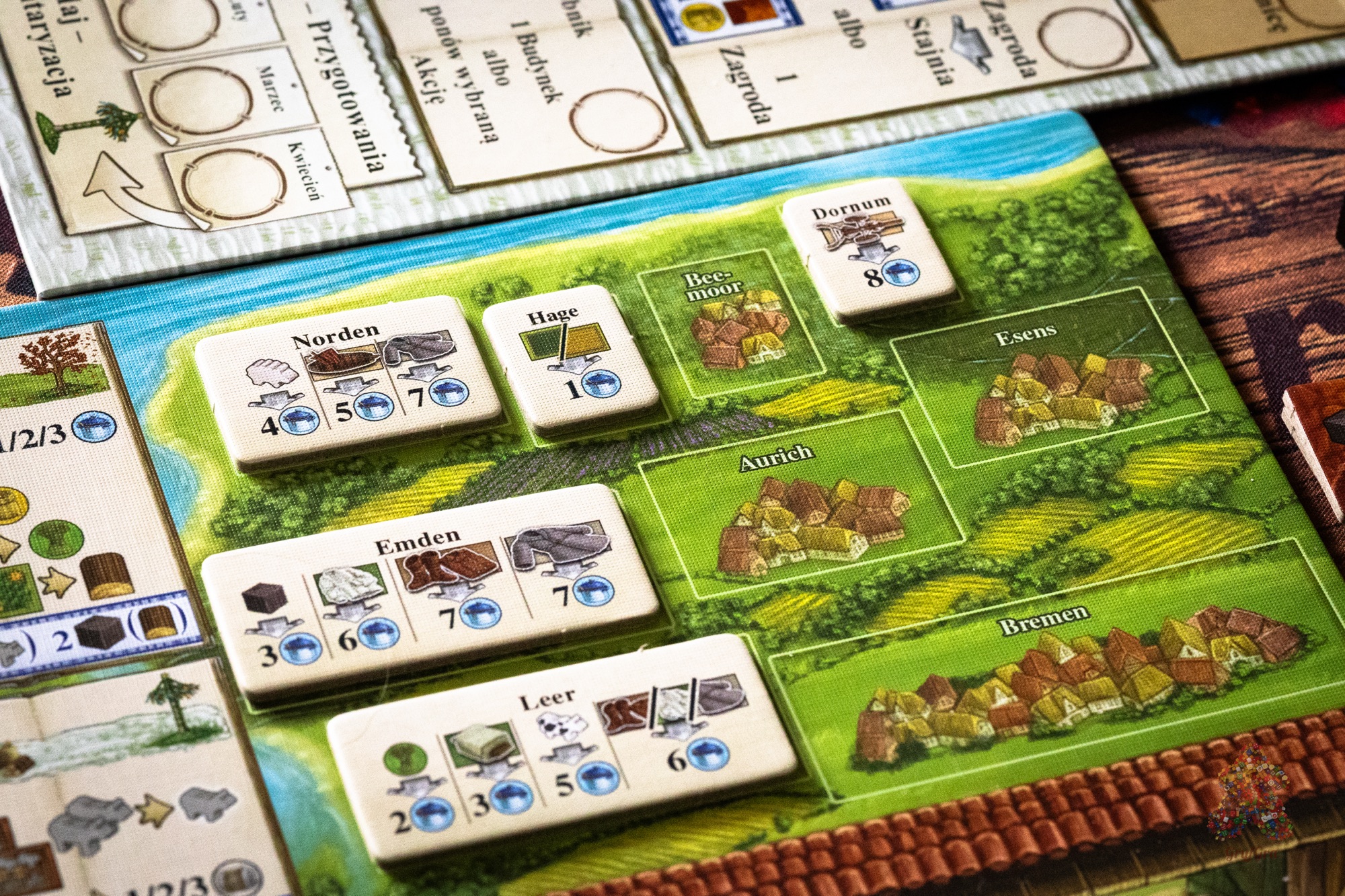
Food is also much more plentiful than in Agricola. We cannot recall a situation in which we had to worry about how we would feed the farm. One could imagine an advanced variant in which feeding people and Animals would present a greater challenge. It seems, however, that the reduced pressure was a deliberate design choice. Feeding remains a minor obligation to remember, but it never overshadows the game’s many other possibilities. It is a good thing all that accumulated Food does not spoil.
Freedom and Point Salad
Fields of Arle offers an enormous amount of freedom, although its scoring system encourages broad development rather than extreme specialisation. Animals are a good example. The species we own the least of provides the most points, while the largest herd scores nothing. It is therefore beneficial to keep the three types of Animals in relatively equal numbers. At the same time, we cannot neglect Buildings, Tools, Travel Destinations, processed goods, or the potential penalties on the Home Board.
The result is a considerable point salad. Assessing your own position is not easy, while calculating an opponent’s score seems so time-consuming that it is usually better to concentrate on developing your own estate. Despite the competition for Action Spaces, we therefore spend most of the game working on our individual puzzles.
In this respect, the game differs noticeably from the more down-to-earth Agricola and Caverna, where the perspective of a farmer managing a family is more strongly felt. In Fields of Arle, we view the farm through the eyes of a landowner overseeing a sizeable estate. We do not need to know where the farmhands took the Wood and Clay—the important thing is that they return with Timber and Bricks.
An East Frisian Farm
Despite its many mechanisms, this is not an abstract puzzle. Dikes, Moors, changing seasons, Animal husbandry, journeys to nearby towns, and the processing of materials combine to create a coherent impression of an East Frisian landowner’s daily life. The autobiographical background is not required to understand the game, but it helps explain why its individual elements have been portrayed in such detail.
Nine Half-Years provide the right length for the game. We could imagine continuing for a few more rounds to maximise our scores and construct additional Buildings, but the experience would probably become less interesting as a result. Our first games took at least two hours, excluding setup and packing everything away. Once we became familiar with the game, this dropped to around ninety minutes.
The variable selection of Buildings and the large number of possible development paths provide considerable replayability. It will take many sessions to explore all the relationships between the systems, and even then the game is unlikely to become boring quickly. This is not, however, a title we would want to play several times in succession. Fields of Arle works better as a game brought to the table occasionally, whenever we feel like tackling something more substantial.
It is primarily a game for experienced fans of economic games who are not discouraged by lengthy setup, numerous available actions, and point-salad scoring. In return, they will find an engaging game with a simple core, plenty of freedom, and a satisfying process of transforming a modest farm into an extensive and efficiently functioning estate.
Summary
Fields of Arle is an extensive economic worker-placement game centred on resource management and developing an individual estate. The basic turn structure is simple, but the number of available actions and interconnected systems means that learning the game takes time.
The division between Summer and Winter requires advance planning, improving Tools gradually increases efficiency, and draining Moors and moving Dikes effectively illustrates the transformation of the estate. Vehicles, which are used both to process materials and conduct trade, provide another interesting element.
The game requires a large table, takes time to set up, and an initial play may last more than two hours. It is therefore not the best choice for beginners or players looking for quick and direct competition. Experienced Eurogame enthusiasts, however, will find considerable freedom, numerous development possibilities, and the satisfying experience of building an increasingly efficient East Frisian estate.