

We know this song and can hum the tune, but do we really remember the lyrics? “Bet The Music” from Trefl tests both our musical memory and our ability to judge our chances. Designed by Krystian Munia from a concept by Przemysław Błażejak, it has us betting on tasks involving singing, humming and naming songs. Higher stakes offer more points, but also give our opponents more time to use the answer we had in mind.
Gameplay
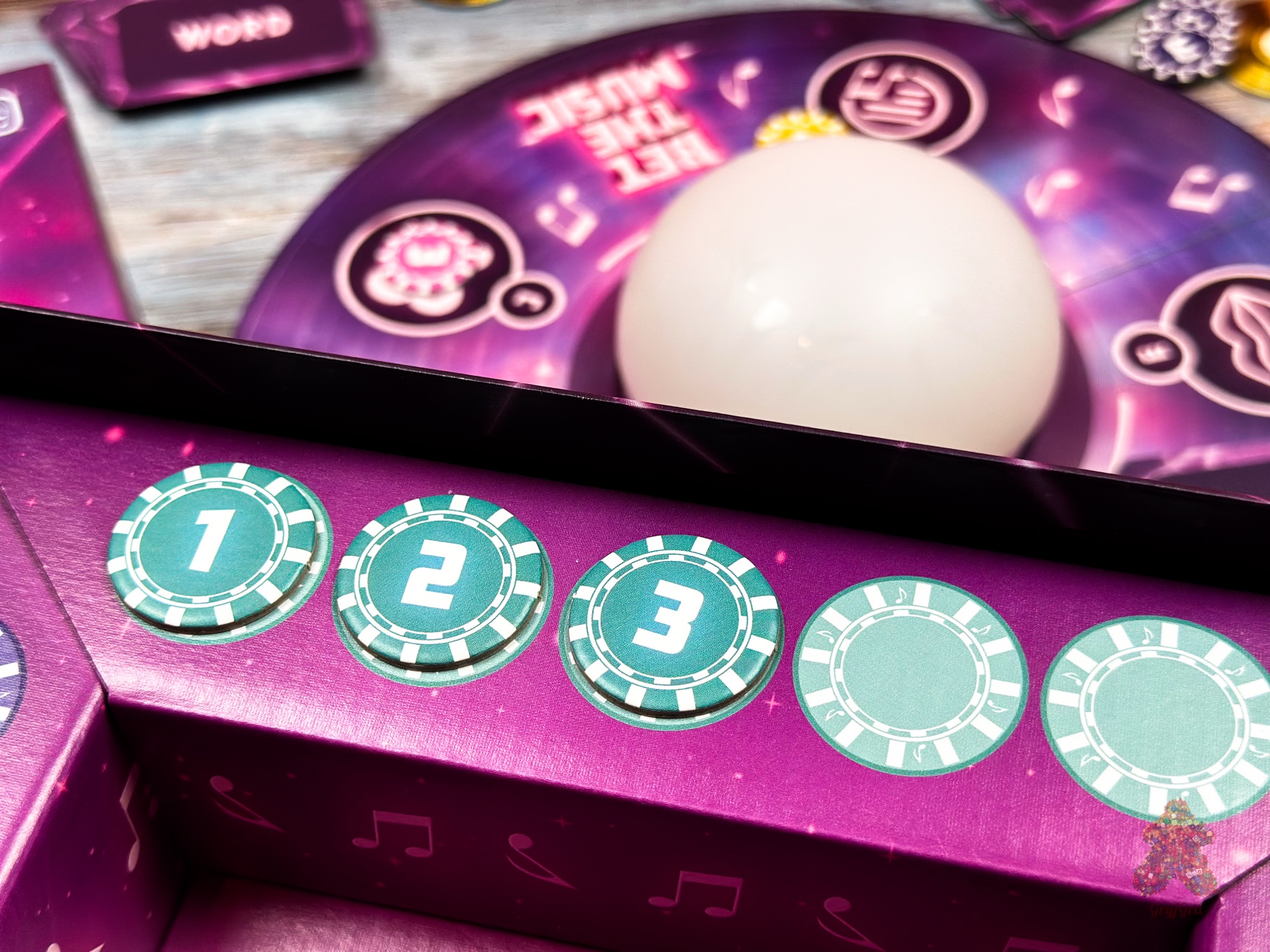
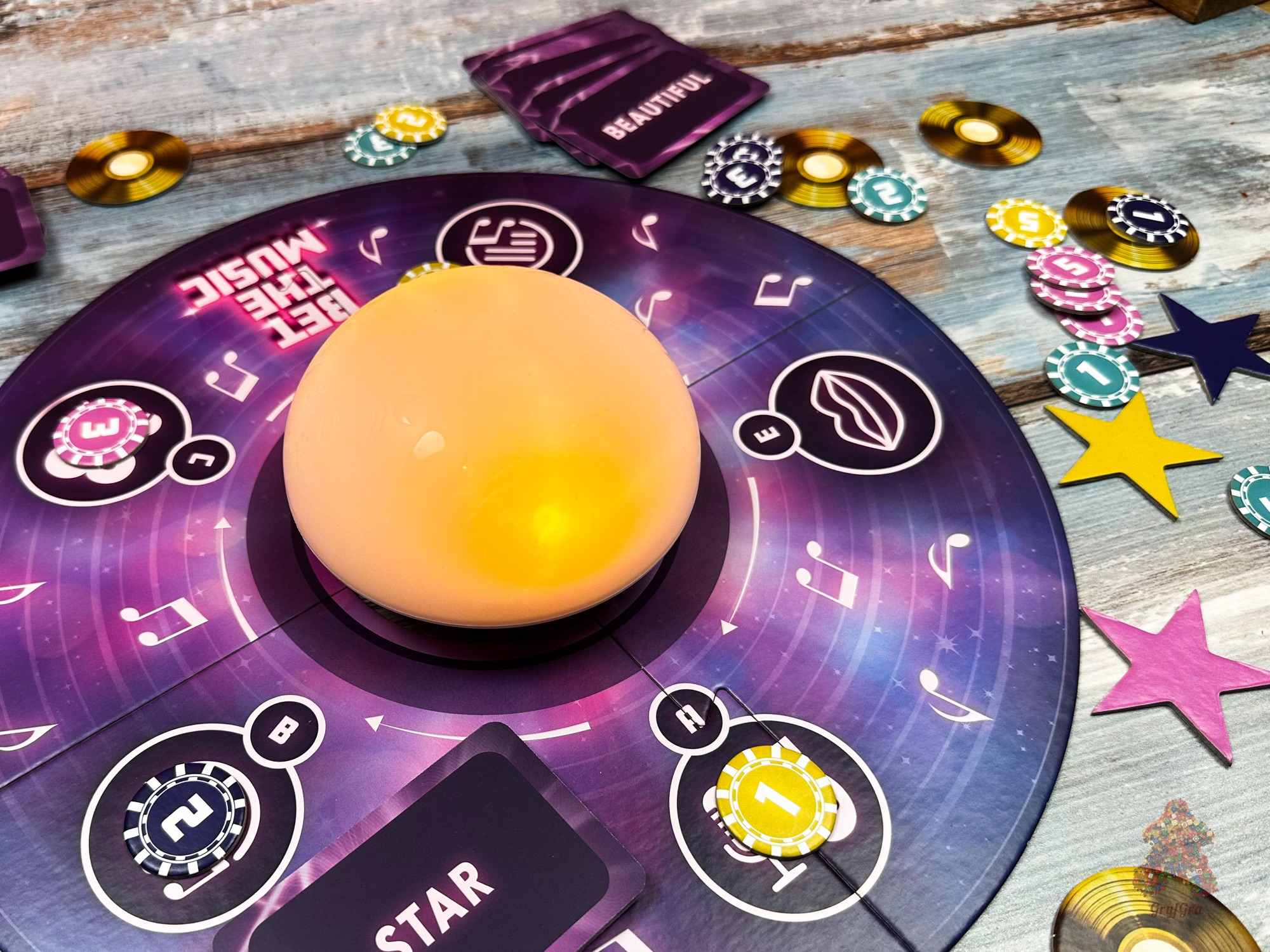
We play in two, three or four teams. The game is for 2–16 players aged 16 and up, with an estimated playing time of 20 minutes. Each team receives five betting tokens valued from 1 to 5. We place the board with its task spaces and music button in the middle of the table, with the deck of prompt cards and the podium built into the box insert nearby. With fewer teams, some spaces on the board are covered.
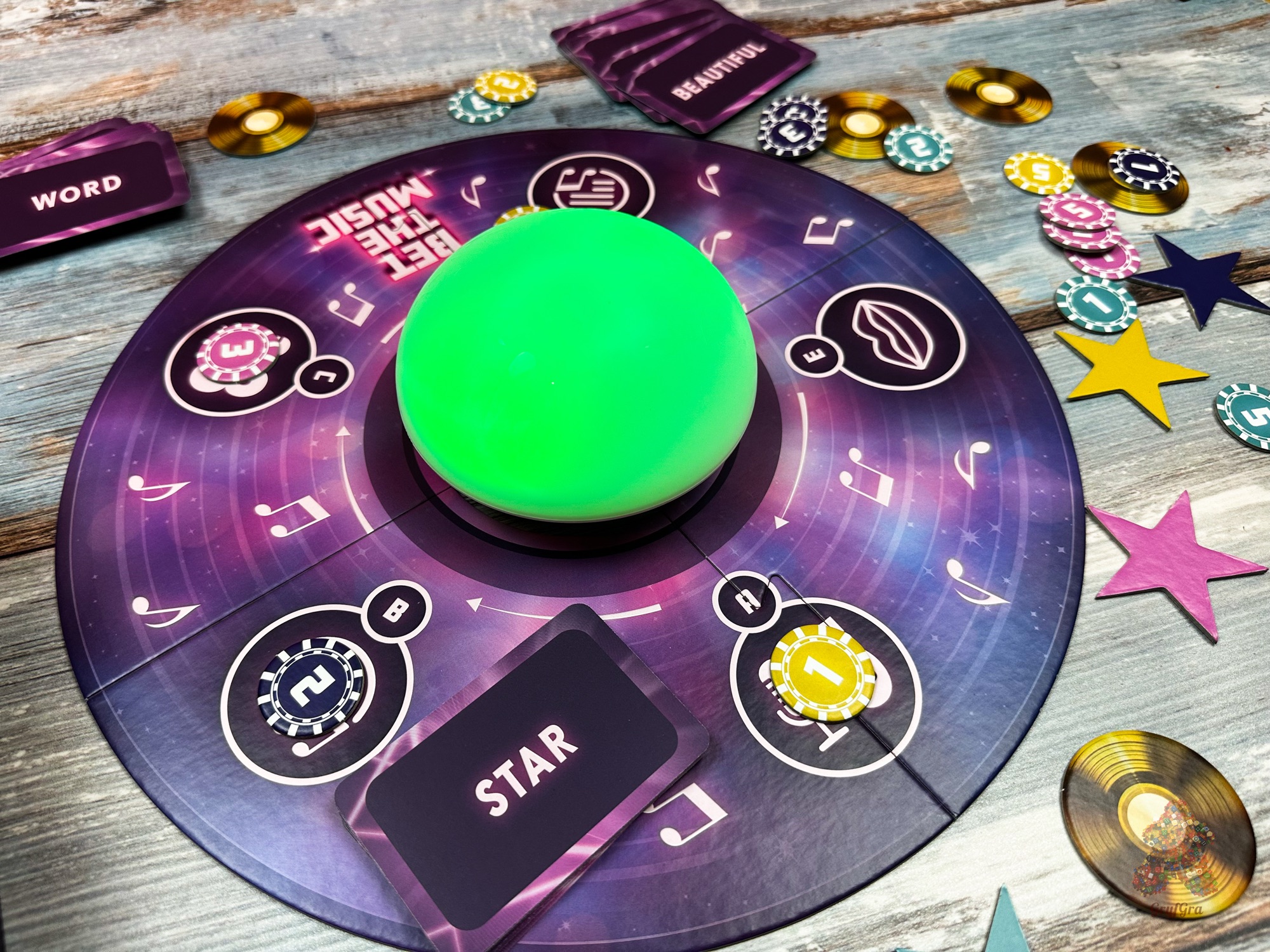
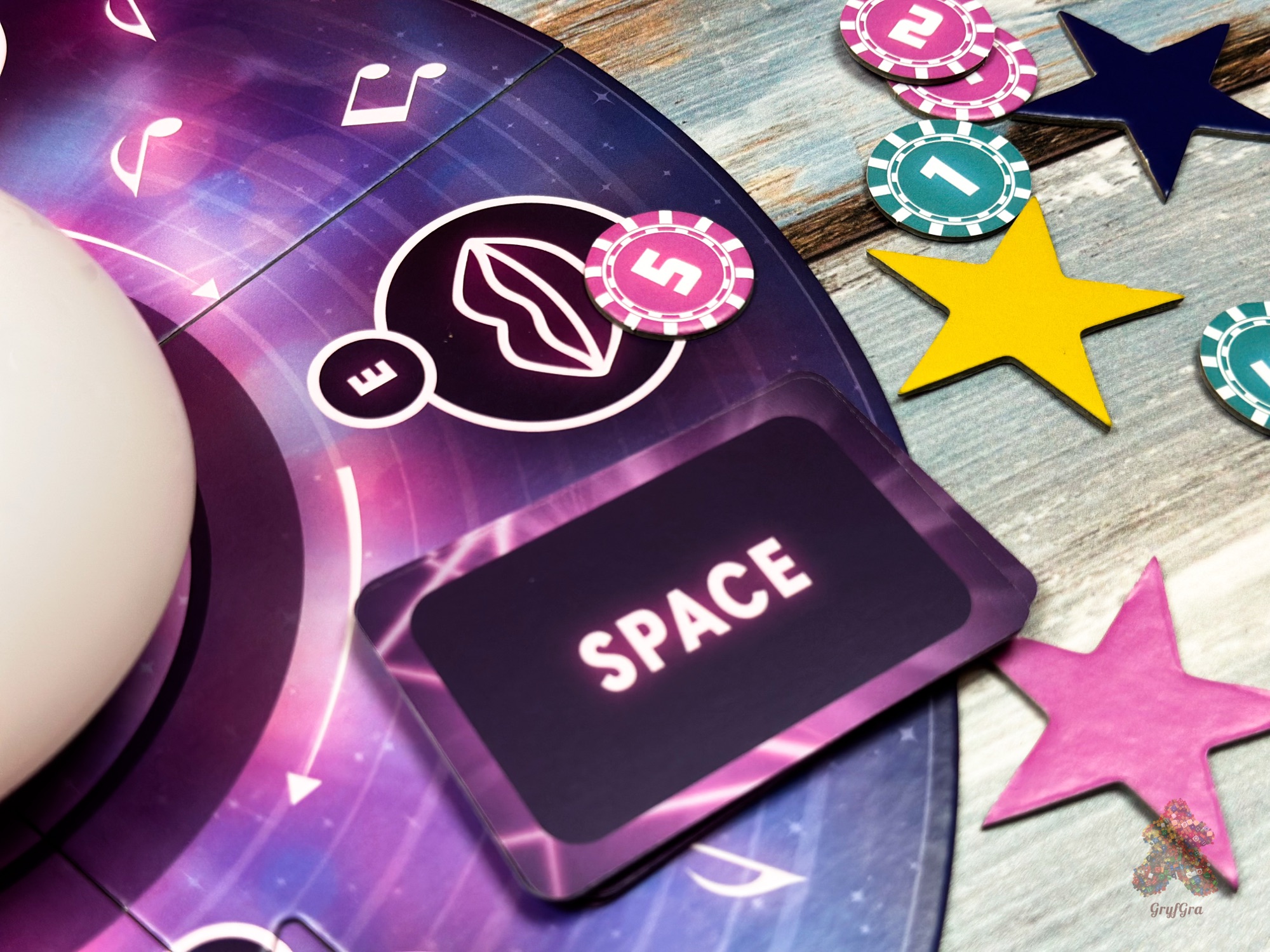
We reveal a prompt card and start the button, which times the betting phase. Each team chooses a task and places one of its available tokens on the matching space. Each space can hold only one bet. Tasks include singing a passage of at least three or five consecutive words, naming a song title, or humming a tune. When singing, the passage must include the prompt word; when naming a title, the word must appear in that title. For humming, we need a song whose lyrics contain the word. Although the prompts are in English, equivalents in other languages and inflected forms are allowed.
Bets are resolved from the lowest token value to the highest, with equal bets settled in board space order. Before each answer, we start the button again. As soon as the music stops, the team must perform its task. The other teams judge whether it succeeded. A successful token goes onto the podium to score points, while an unsuccessful one is set aside for the rest of the round. Crucially, songs and titles already used during the same turn cannot be repeated.
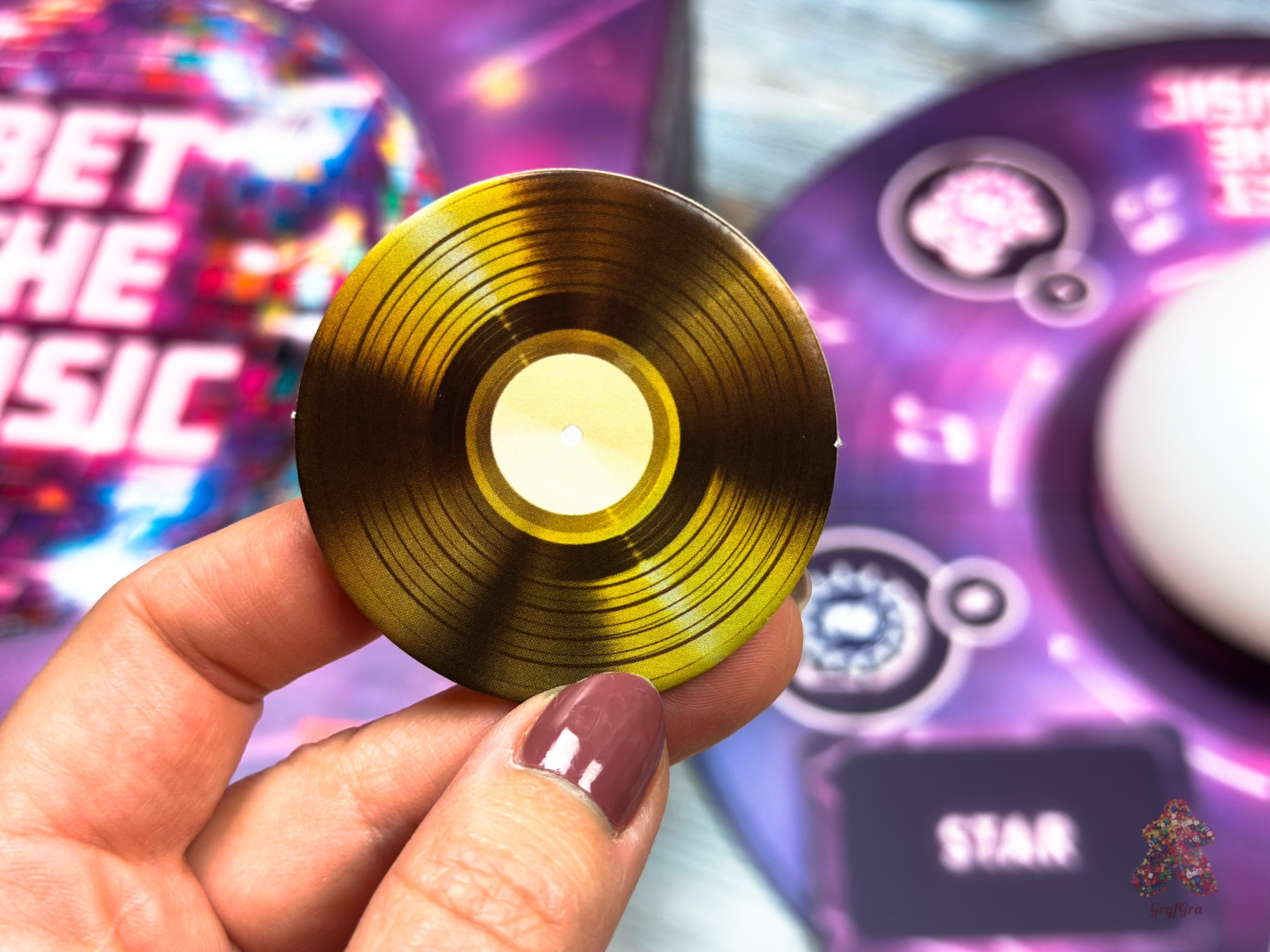
A round ends after a turn in which at least one team has run out of tokens. We add up the values of successful bets, and the winning team receives a golden vinyl record token. Ties are settled by a singing tiebreaker with a race to press the button. We then take back our betting tokens and begin the next round. The first team to collect two records wins the game.
Review
“Bet The Music” is a light party game that combines knowledge of songs with a simple but meaningful choice of stakes. Our experience comes from playing with three people, each acting as a separate team. We could not gather a larger group, so we cannot assess cooperation within teams or how the game works with a full table of up to sixteen players. Even with our small group, though, there were plenty of opportunities to take each other’s answers and laugh at our unreliable memories.
Setup takes a few minutes, and explaining the rules is quick. Once we know the tasks and the order in which bets are resolved, everything is clear. That suits a game we want to bring out during a get-together without a lengthy introduction. The total playing time depends on how the round wins are distributed. A team that bets well and completes its tasks can win after just two rounds, although such a quick finish was not the norm for us.
Betting is the most interesting part for us. A low-value token offers a smaller reward but lets us answer earlier. A high one could score more points, yet someone might use our chosen song before our turn arrives. Simply being certain that we know a song is therefore not enough to make a safe bet of five. We also need to consider how obvious our choice is and whether we have a backup answer.
Opponents did take the songs we had in mind during our games. That made less obvious choices useful when placing higher bets. It is a simple relationship, but it makes betting a meaningful part of the game. While others answer, we try to keep our own song in mind and listen to check whether we will still be allowed to use it. Someone else’s answer can force a quick change of plan.
Naming titles seemed like the easiest option in theory. In practice, fragments of lyrics came to mind more often than specific titles that matched the prompt. Knowing a melody and feeling sure that we remember a song can also be misleading. The biggest laughs came when we began confidently, only to discover moments later that we did not actually know what came next.
Singing in front of others felt a little awkward at first. Over time, it became one of our main sources of fun. This is also something to consider when choosing a group: the atmosphere depends largely on whether people want to have a go and can laugh at their own mistakes. The game provides the opportunities, while the people around the table shape the experience.
English prompts do not restrict us to a single repertoire. English-language songs often came to mind, but being able to translate the word also let us use Polish songs. That is a helpful option for players who are less comfortable with English. Generational differences were not a problem for us, as everyone could draw on the music they knew. We are finding our own suitable example rather than trying to guess one particular song chosen by the designers.
Our biggest reservation concerns the music button. We did not find its sound pleasant, and its five-second timer was too short for us. Eventually, we replaced it with a separate timer and allowed ourselves longer. This was our own house rule, rather than a variant described in the rulebook. We continued playing with that adjustment, so our assessment of the experience needs to be read with this change in mind.
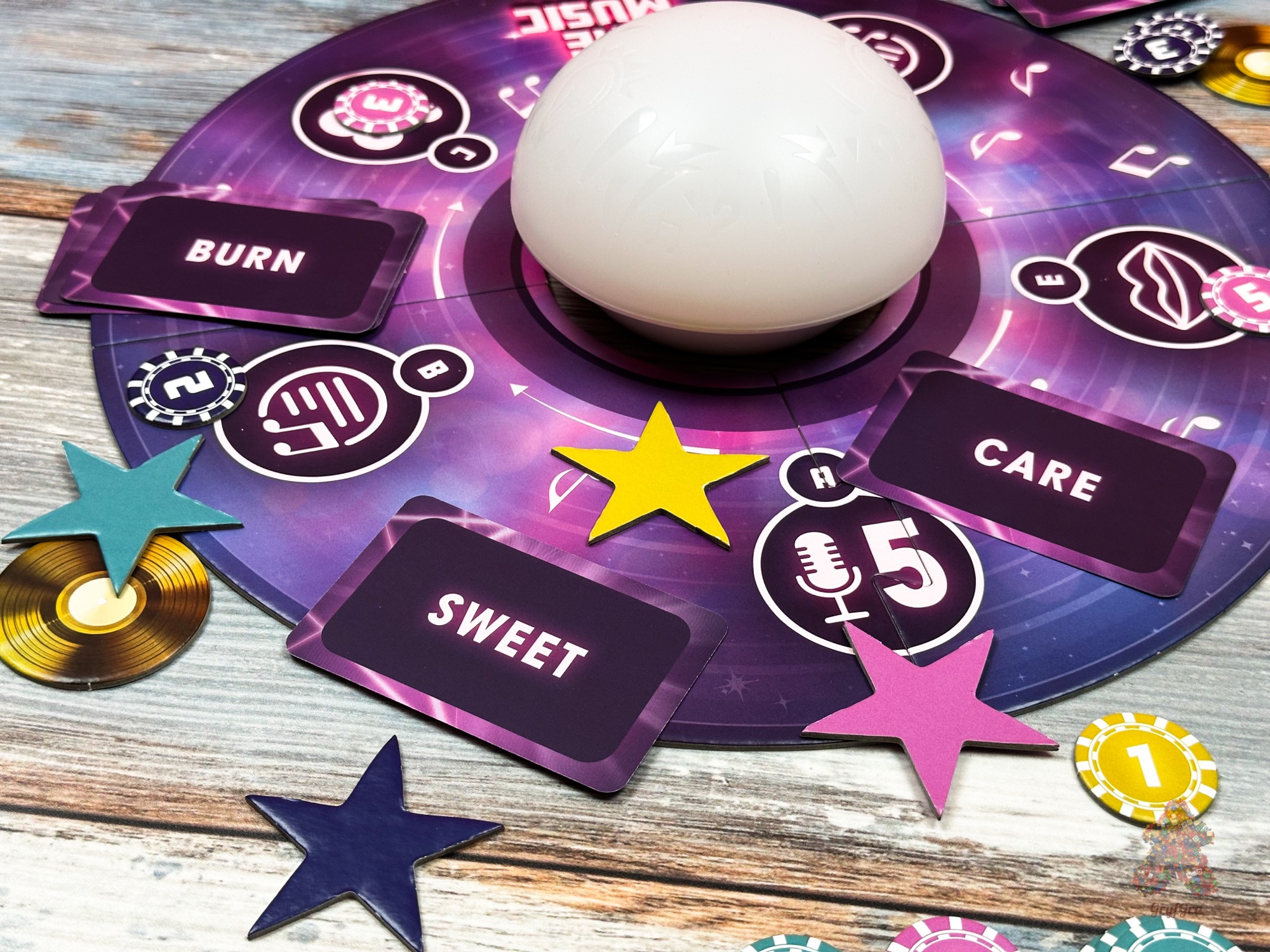
Apart from the button, we had no major complaints about production quality. The components were convenient to use, and the 56 double-sided cards gave us enough prompts. We did not feel that the challenges were quickly running out. A single word can also suggest many different songs, so seeing a prompt again does not necessarily mean giving the same answer.
Summary
“Bet The Music” offers an enjoyable mix of musical associations, singing and judging risk. Its strongest idea is the link between the value of a bet and the order of answers: a bigger reward is tempting, but opponents may use our song first. The rules are quick to learn, and getting the lyrics wrong can provide as much fun as a successful performance.
We recommend it primarily to people looking for a light party game and groups keen to sing and laugh at their own memories. It worked for us with just three players, although we did not test larger teams. The main drawback was the button, with its unpleasant sound and a time limit that felt too short for us. We enjoyed playing after replacing it with a separate timer, but both that adjustment and the importance of the right company are worth bearing in mind.
Thank you to Trefl for providing a copy of the game for review.
